CIPD Level 3 Assignment Examples — Foundation Certificate in People Practice
This page contains worked assignment examples for every module in the CIPD Level 3 Foundation Certificate in People Practice. Examples are organised by pathway — four mandatory core units plus HR or L&D pathway options — so you can find the module your approved centre has set and understand the standard of response required to pass each Assessment Criterion.
What is the CIPD Level 3 Foundation Certificate in People Practice?
The CIPD Level 3 Foundation Certificate in People Practice is the entry-level CIPD qualification for those beginning a career in HR or L&D. It sits at Level 3 on the Regulated Qualifications Framework (RQF) in England and Wales — equivalent to A-Level standard — and awards Foundation CIPD membership upon successful completion. The qualification is recognised across the United Kingdom and by CIPD's international affiliate network, including centres in the United Arab Emirates, Saudi Arabia, Ireland, and Qatar.
The qualification is built around four mandatory core units that every student completes, regardless of whether they are pursuing an HR or L&D specialism. These core units establish foundational understanding of how businesses operate, how data supports people decisions, what professional behaviour looks like in a people practice context, and how the essential activities of HR — recruitment, reward, employment law — function in practice. Pathway units then allow students to go deeper into either HR or L&D subject matter.
Assessment is entirely written. There are no examinations. Each unit is assessed through a portfolio of activities, each mapped to specific Assessment Criteria (ACs). The qualification typically takes 9 to 12 months to complete on a part-time basis. No prior HR or L&D qualification is required — it is designed as a starting point. Most approved centres accept career changers, those new to their HR support role, and professionals seeking to formalise on-the-job experience.
How CIPD Level 3 Assignments Are Assessed
CIPD Level 3 assignments are assessed as pass or refer — there is no merit or distinction grade at this level. A pass requires every Assessment Criterion in the unit to be addressed with a clear, applied response. Assessors are looking for evidence that you understand the concept being tested and can connect it to an organisational context — your current employer, a previous employer, or a case study provided by your centre.
Level 3 responses are practical and operational in tone. You are not expected to compare competing academic theories or produce multi-framework critical analysis — that is a Level 5 and Level 7 expectation. At Level 3, one relevant model or framework applied accurately to a real-world example is sufficient evidence for a pass-standard response. Every sentence should add practical information; describing theory without connecting it to an organisation or workplace scenario is the most common reason assessors issue referrals at this level.
Individual activity word limits at Level 3 range from 500 to 1,200 words per question, with total unit submissions running approximately 1,500 to 2,500 words. Your approved centre's assessment brief sets the exact limits. If your centre issues a referral, the feedback will specify which AC was not adequately addressed and what needs to be added or clarified — resubmissions are targeted to those specific sections only.
CIPD Level 3 Core Unit Assignment Examples
All four core units are mandatory for every Level 3 student, regardless of whether they follow the HR or L&D pathway. These units form the foundation of the CIPD qualification framework and connect directly to their Level 5 counterparts — 3CO01 connects to 5CO01, 3CO02 connects to 5CO02, and so on.
- 3CO01 — Business, Culture and Change in Context
Covers how the external business environment shapes organisational strategy, what organisational culture means and how it influences behaviour, and how HR and L&D practitioners operate within and respond to change. The entry-level counterpart to 5CO01. - 3CO02 — Principles of Analytics
Covers how to use data and evidence to support people practice decisions, the basics of HR metrics, and how to present insights to stakeholders. The entry-level counterpart to 5CO02. - 3CO03 — Core Behaviours for People Professionals
Covers the CIPD Profession Map behaviours, ethical practice, continuous professional development (CPD), and how to act as a credible people practice professional in an organisational setting. - 3CO04 — Essentials of People Practice
Covers the operational essentials of HR: recruitment and selection, employment contracts, reward basics, performance management, and the legal framework governing individual employment relationships in the UK.
CIPD Level 3 HR Pathway Assignment Examples
Students following the HR pathway at Level 3 complete two specialist units focused on supporting good employment practice — covering performance management, reward, and employment relations at an operational level.
- 3HR01 — Supporting Good Practice in Performance and Reward Management
Covers how to support the performance management cycle, the principles of reward and recognition, and how to apply these in a fair and consistent way that supports employee motivation and organisational goals. - 3HR02 — Supporting Good Practice in Managing Employment Relations
Covers individual and collective employment relations, the role of the HR practitioner in handling grievance and disciplinary procedures, and the basics of employment law relevant to managing the employment relationship.
CIPD Level 3 L&D Pathway Assignment Examples
Students following the L&D pathway at Level 3 complete one specialist unit focused on supporting colleagues through individual learning and development processes.
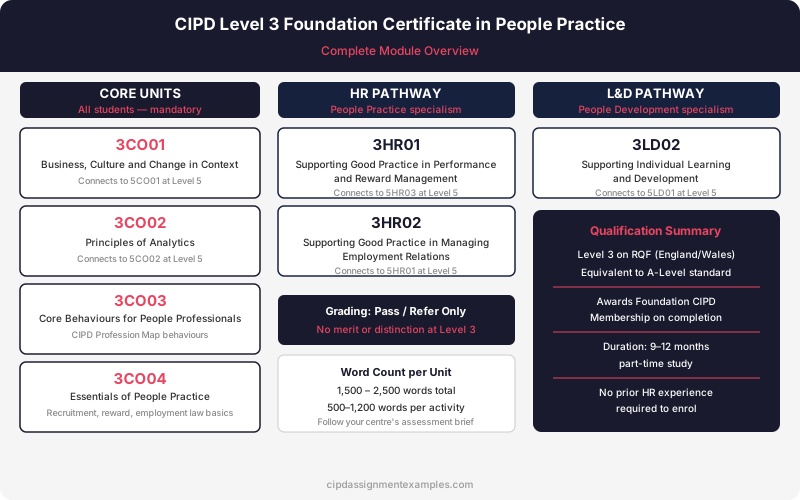
- 3LD02 — Supporting Individual Learning and Development
Covers how to identify individual learning needs, how to select and recommend appropriate learning interventions, and how to support colleagues through a structured learning and development process. This unit connects directly to the Level 5 L&D pathway entry point at 5LD01.
The most effective CIPD Level 3 assignments share one characteristic: every response connects knowledge to a specific organisational example. Assessors are not testing whether you can recall theory — they are testing whether you can explain what that theory means in practice, in a real workplace. The worked examples on this site demonstrate how to build that practical connection into every AC response, and how to structure your answer so that the assessor can clearly see which criterion is being addressed and where.
Word Count and Marking Guidance for CIPD Level 3 Assignments
CIPD Level 3 assessments are shorter and more focused than Level 5. The structure is designed for practitioners who are building foundational knowledge — responses need to be clear and applied, not academically extended. Typical word count ranges by unit are:
- Core units (3CO01–3CO04): 1,500–2,500 words total per unit. Individual activities within the unit commonly carry limits of 500–900 words per question.
- HR pathway units (3HR01, 3HR02): 1,200–2,000 words per unit. Scenario-based questions typically require 400–800 words to address the AC at pass standard.
- L&D pathway unit (3LD02): 1,200–2,000 words. Activities will involve identifying learning needs, selecting methods, and evaluating outcomes.
Level 3 does not require academic referencing, but citing a relevant CIPD factsheet, theory, or model strengthens your response. CIPD produces free factsheets on every topic area at Level 3 — these are the primary evidence source expected at this level. Referencing is informal: "According to the CIPD's factsheet on performance management (2024)..." is sufficient.
There is no merit or distinction at Level 3. Every AC must be addressed to a pass standard. If one AC is passed and another is not, the assessor will refer the whole activity — not just the weak AC — and request resubmission of the activity with all ACs re-addressed to avoid partial marking confusion.
Progressing from CIPD Level 3 to Level 5
CIPD Level 3 is the foundation of the qualification framework. Students who complete the Foundation Certificate and wish to advance to Associate-level practice can progress to CIPD Level 5 (Associate Diploma in People Management), where the same subject areas — organisational context, analytics, professional behaviour, employment law — are revisited at a higher analytical depth. Level 5 requires the same topics to be treated with theoretical comparison, critical evaluation, and scenario-based complexity that Level 3 does not demand.
CIPD does not require Level 3 completion before enrolling in Level 5. Candidates with substantial HR or L&D experience can enter at Level 5 directly via an approved centre assessment. However, students who have completed Level 3 will find Level 5 significantly more navigable — the assessment structure, AC format, and portfolio methodology are identical; what changes is the depth, word count, and analytical expectation of every response.
CIPD Level 3 Assignment Examples — Frequently Asked Questions
What is the CIPD Level 3 Foundation Certificate in People Practice?
The CIPD Level 3 Foundation Certificate in People Practice is the entry-level CIPD qualification for people beginning their career in HR or L&D. It sits at Level 3 on the Regulated Qualifications Framework (RQF) — equivalent to A-Level standard — and awards Foundation CIPD membership upon completion. The qualification covers the fundamentals of people practice: business and organisational context, data and analytics, professional behaviours, and the essentials of employment practice.
How many modules are in the CIPD Level 3 qualification?
The CIPD Level 3 Foundation Certificate requires completion of four mandatory core units (3CO01, 3CO02, 3CO03, 3CO04) plus pathway-specific units depending on whether you are studying the HR or L&D route. Most students complete between five and seven units in total, depending on their approved centre's programme structure.
What word count is required for CIPD Level 3 assignments?
CIPD Level 3 assignments are shorter than Level 5. Individual activities typically require 500–1,200 words per question, with total unit submission lengths of approximately 1,500–2,500 words. Your approved centre's assessment brief specifies the exact word count for each activity.
Do CIPD Level 3 assignments have a merit or distinction grade?
No. CIPD Level 3 assignments are graded as pass or refer (not pass). There is no merit or distinction grade at Level 3. A pass requires all Assessment Criteria to be addressed with applied examples. If any AC is not adequately addressed, the assessor will issue a referral with specific feedback on what needs to be resubmitted.
What is the difference between the HR and L&D pathways at CIPD Level 3?
The HR pathway at Level 3 covers employment relations and performance and reward management through units 3HR01 and 3HR02 — focusing on how HR supports employees through operational people management practices. The L&D pathway covers individual learning and development through unit 3LD02 — focusing on how to support colleagues in identifying and meeting their learning needs. Both pathways share the four mandatory core units.
Can I do CIPD Level 3 without any prior HR experience?
Yes. CIPD Level 3 is designed as an entry point into HR and L&D and does not require prior HR experience. Some approved centres accept school leavers and career changers with no people management background. The qualification is structured to build foundational knowledge from first principles. However, you will need to apply learning to an organisational context in your assignments — most students use their current employer, a previous employer, or a case study provided by their centre.